Call Us Now
 Email Us Now


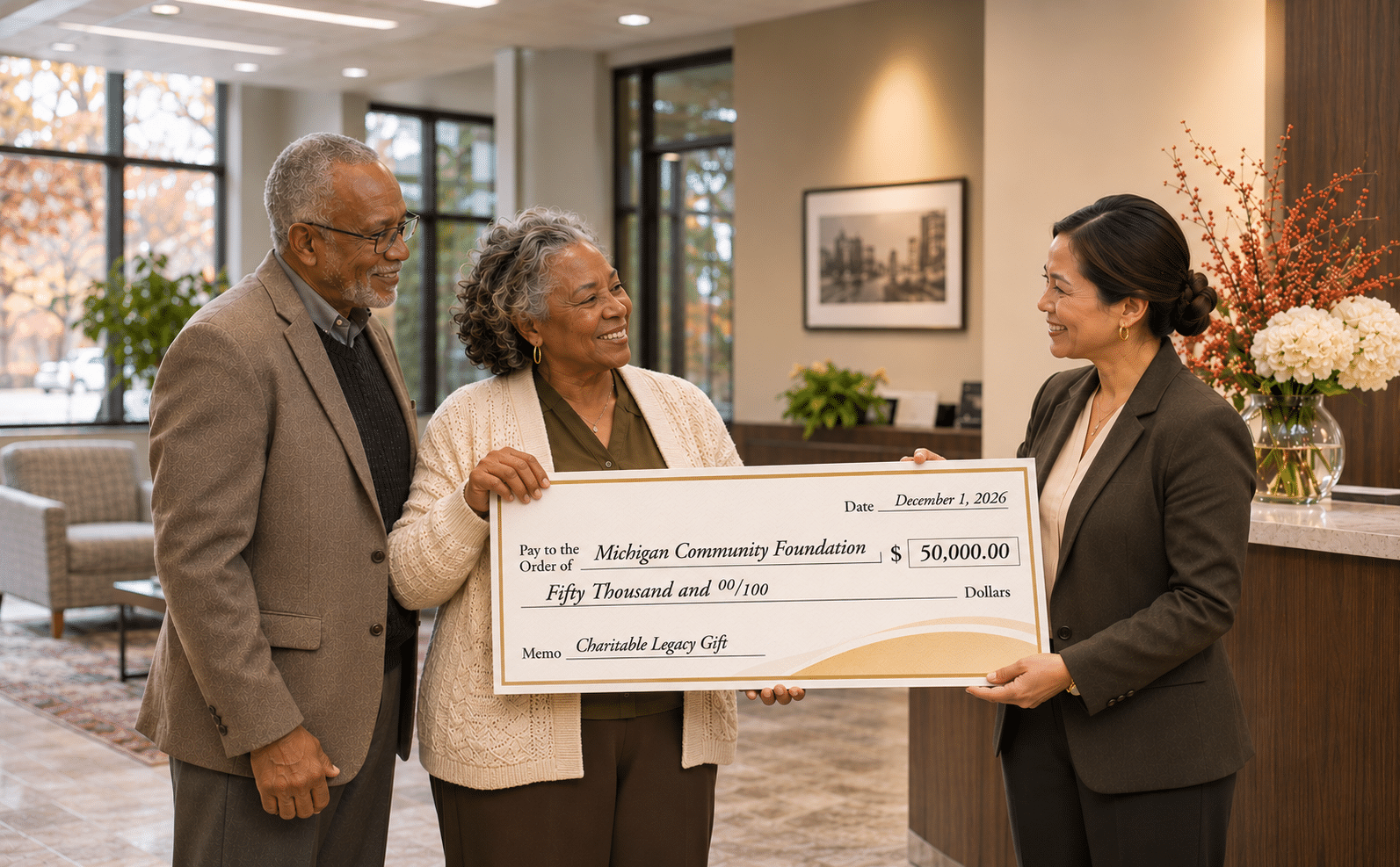
As the year winds down, generosity often becomes part of the conversation.
There are holiday fundraisers, community organizations asking for support, and causes that remind us of the people and places that have shaped our lives.
For some, giving means writing a check to a favorite charity. For others, it means supporting a local food pantry, a scholarship program, an animal rescue, or an organization that made a difference during a difficult chapter.
But charitable giving can raise a question that goes beyond December.
What happens to the causes you care about when you’re no longer here to support them?
For Michigan individuals and families, that question can connect charitable giving to estate planning in ways that aren’t always obvious. A gift made today, a charitable provision in a will or trust, and a beneficiary designation on a retirement account can accomplish different things.
Understanding those differences is a useful place to begin.
The right approach often depends less on the calendar than on how much control, flexibility, and access to your assets you want to keep. Below, we look at charitable bequests, donor-advised funds, and retirement accounts, then turn to which decisions actually depend on December 31.
DOES CHARITABLE GIVING HAVE TO HAPPEN NOW?
Not necessarily. Imagine someone who has supported the same Michigan community organization for 25 years. They make a contribution every December, attend occasional fundraising events, and believe strongly in its mission.
They would like that support to continue after their death, but they also want to preserve their savings for retirement and possible long-term care needs.
A charitable bequest may offer one way to accomplish that goal.
Through a will or trust, an individual may arrange for a qualifying charitable organization to receive a specific dollar amount, particular property, or a percentage of their estate after death.
For example, someone might leave 5% of their estate to a local animal shelter while directing the remainder to family members.
The gift generally does not require them to part with those assets during their lifetime.
But the details matter.
A charitable provision should identify the intended recipient clearly and fit within the broader estate plan. Families should also consider how the gift might affect other beneficiaries and what happens if the organization changes its name, merges, or ceases operating.
A bequest is more than an expression of generosity. It is a legal instruction that should be drafted with the same care as any other estate planning provision.
WHAT IF YOU WANT TO GIVE NOW, BUT DECIDE LATER?
Some people know they want to support charitable causes but aren’t ready to decide exactly how their contributions should be distributed.
A donor-advised fund, often called a DAF, offers a different approach.
A donor contributes assets to an account maintained by a sponsoring charitable organization. The sponsoring organization legally controls those assets, while the donor generally retains the ability to recommend grants to eligible charities.
Consider a Michigan couple who have supported several causes over the years. They want to set aside money for charitable giving now but distribute it gradually, perhaps with input from their adult children.
A donor-advised fund may allow them to make an eligible contribution in one year and recommend grants over subsequent years.
Depending on the circumstances, the initial contribution may qualify for a charitable tax deduction. However, contributions are irrevocable, and the sponsoring organization retains final authority over distributions.
A DAF is not simply a savings account earmarked for charity.
It also isn’t the same as a charitable bequest. With a bequest, the transfer generally occurs after death. With a DAF, the donor gives up legal ownership of the contributed assets during their lifetime.
Some programs also permit donors to designate successors who can recommend future grants, allowing charitable interests to continue across generations.
For many people, the choice between a bequest and a DAF comes down to control.
COULD YOUR IRA BE PART OF YOUR CHARITABLE PLAN?
Retirement accounts introduce another consideration because they can be treated differently from other assets when inherited.
Traditional IRAs and certain other tax-deferred retirement accounts generally carry income tax consequences when individual beneficiaries receive distributions.
Qualified charitable organizations, by contrast, are generally exempt from federal income tax on distributions they receive as beneficiaries.
That difference can make beneficiary designations worth reviewing.
For example, someone who wants to leave assets to both adult children and a charitable organization might consider which assets should go to each recipient.
Depending on the family’s circumstances, naming a qualified charity as a beneficiary of some or all of a traditional IRA may be more tax-efficient than leaving the same retirement assets to individual heirs.
But this is not a universal rule.
Spousal protections, beneficiary requirements, the type of retirement account, other available assets, and the family’s overall financial situation can change the analysis.
It’s also important to understand that retirement account beneficiary designations generally control where those assets go, even if a will contains different instructions.
That makes reviewing beneficiary forms an important part of estate planning, particularly after marriage, divorce, the death of a loved one, or a change in charitable priorities.
CAN YOU GIVE DIRECTLY FROM AN IRA?
For some older donors, charitable giving can also happen during retirement.
A qualified charitable distribution, or QCD, generally allows an eligible IRA owner age 70½ or older to direct a qualifying distribution from an IRA to an eligible charitable organization.
When the applicable requirements are met, the distribution can be excluded from taxable income. It may also count toward a required minimum distribution for someone subject to those requirements. For 2026, the annual QCD limit is $111,000 per eligible IRA owner, and the excluded amount cannot also be claimed as a charitable deduction.
This is different from withdrawing money personally and then making a donation.
The transfer must meet specific rules, including requirements involving the donor’s age, the type of account, the recipient organization, and how the funds are transferred.
There’s also an important limit on where a QCD can go: a distribution to a donor-advised fund, supporting organization, or most private foundations does not qualify as a QCD.
Someone considering both a QCD and a donor-advised fund should not assume they can be combined for the same tax treatment.
The rules can be especially relevant toward year-end, when individuals are reviewing retirement distributions and charitable contributions.
DOES DECEMBER 31 CHANGE YOUR OPTIONS?
Sometimes. But not every charitable planning decision operates on the same deadline.
A qualifying contribution made during 2026 may affect a taxpayer’s 2026 federal income tax return, subject to applicable deduction rules.
For those who itemize, new rules beginning in 2026 generally allow a deduction only for charitable gifts exceeding 0.5% of adjusted gross income, and may limit the deduction’s value for taxpayers in the highest bracket.
For 2026, taxpayers who do not itemize may deduct up to $1,000 ($2,000 for married couples filing jointly) of cash contributions made directly to qualified public charities. Contributions to donor-advised funds, supporting organizations, and most private foundations do not qualify for that deduction.
Other charitable gifts may have different tax treatment depending on the asset contributed, the donor’s circumstances, and applicable limitations.
Meanwhile, establishing a charitable bequest in a will or trust is primarily an estate planning decision. It does not create an immediate personal income tax deduction simply because the provision is added before December 31.
A QCD has its own timing and transfer requirements. Waiting until the final days of December can create processing complications, particularly when financial institutions and charitable organizations have year-end deadlines.
For these reasons, a year-end review should be about more than making a last-minute donation.
It should also consider how current giving, retirement accounts, and future charitable intentions fit together.
WHAT ABOUT THE PEOPLE YOU’RE LEAVING BEHIND?
Charitable giving can be deeply personal, but it rarely exists separately from family responsibilities.
Someone may want to support a favorite organization while also providing for a surviving spouse, helping adult children, or preserving resources for future care.
Others may have a family member with special needs whose inheritance requires additional planning.
Those priorities deserve consideration before making irrevocable gifts or changing beneficiary designations.
A donor-advised fund may appeal to someone who wants to establish a long-term charitable tradition. A bequest may be more appropriate for someone who wants to retain control of their assets during life. A retirement account beneficiary designation may be worth examining when tax-deferred savings form a significant part of the estate.
None of these approaches should be evaluated solely by the possibility of a tax advantage.
The better question is how each decision affects the people, responsibilities, and causes that matter to you.
MAKE GENEROSITY PART OF THE PLAN
The end of the year naturally encourages reflection. We think about what we’ve accomplished, what has changed, and what we want to carry forward.
Charitable giving can be part of that reflection.
But generosity doesn’t have to be confined to a December contribution. It can also influence how an estate is structured, how retirement assets are distributed, and how a family’s values continue to find expression in the years ahead.
If you’re considering a charitable bequest, reviewing retirement account beneficiaries, or exploring how charitable giving fits into your Michigan estate plan, a conversation with one of our attorneys at Estate Planning & Elder Law Services, P.C. can help. We can walk through the legal considerations and identify next steps to discuss with your tax or financial advisor.
Call (888) PLAN-050, email in**@*******an.com, or visit https://www.formyplan.com/estate-planning/ to request a consultation.
This article provides general information, not legal or tax advice, and does not create an attorney-client relationship.